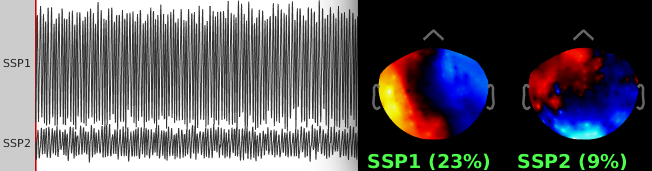
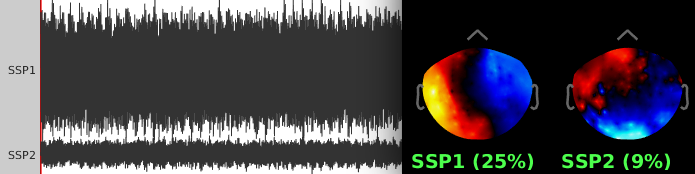
1. Strong wide peak, slow frequency sweep
We finally determined this is an issue with the MEG electronics warming up. It only occurs “soon” after system startup, and lasts only a few minutes. So always start the MEG electronics and the acquisition software in “preview” mode, some time ahead of doing an initial recording, typically the empty room noise collection. Unfortunately, the delay for the system to warm up and the artefact to appear varies with the seasons (likely due to temperature and humidity changes), and can be over an hour in the summer.
It has to do with the electronics clock being sensitive to temperature, and interacting with environmental noise, likely the 60 Hz power line noise. It’s very noticeable as increased high frequency noise in many channels. On the spectrum, it is a wide peak with side lobes, that slowly sweeps down, “bounces” at 0 Hz and then sweeps up until it disappears past our filter and sampling rate limits.
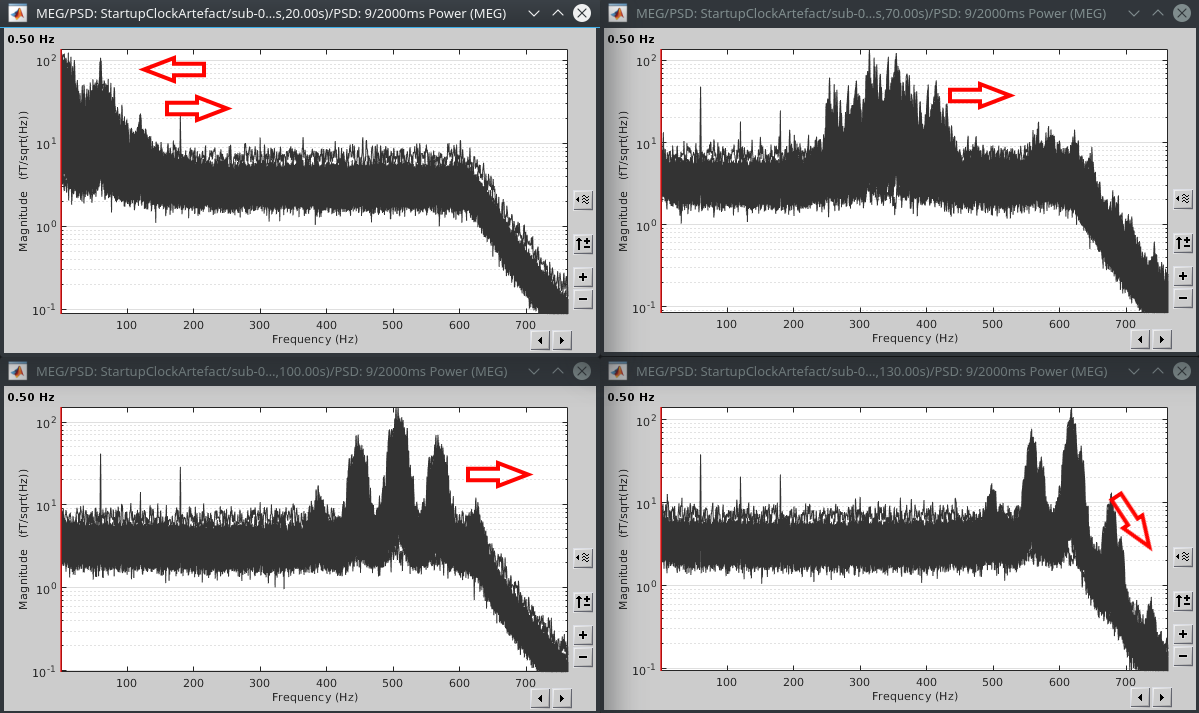
If this artefact is present in some data, it should clean fairly well with two SSP components. Thankfully, the sensor pattern doesn’t change as the artefact frequency evolves, so once the components are found by analyzing say 10 seconds of data focussing on the frequency range where the artefact is present, they can be used to clean the entire dataset, and even others. Here are the components obtained for the first three time windows displayed above, using appropriate frequency ranges for each: